The M 149 Tube* is a variable dual-diaphragm microphone. The K 49 capsule – well-known from the legendary U 47 and M 49 microphones – is followed by a tube functioning as an impedance converter. In contrast to earlier concepts – utilizing a transformer – the tube is complemented with a transformerless output circuit design. The M 149 Tube can thus feed long microphone cables without any coloration.
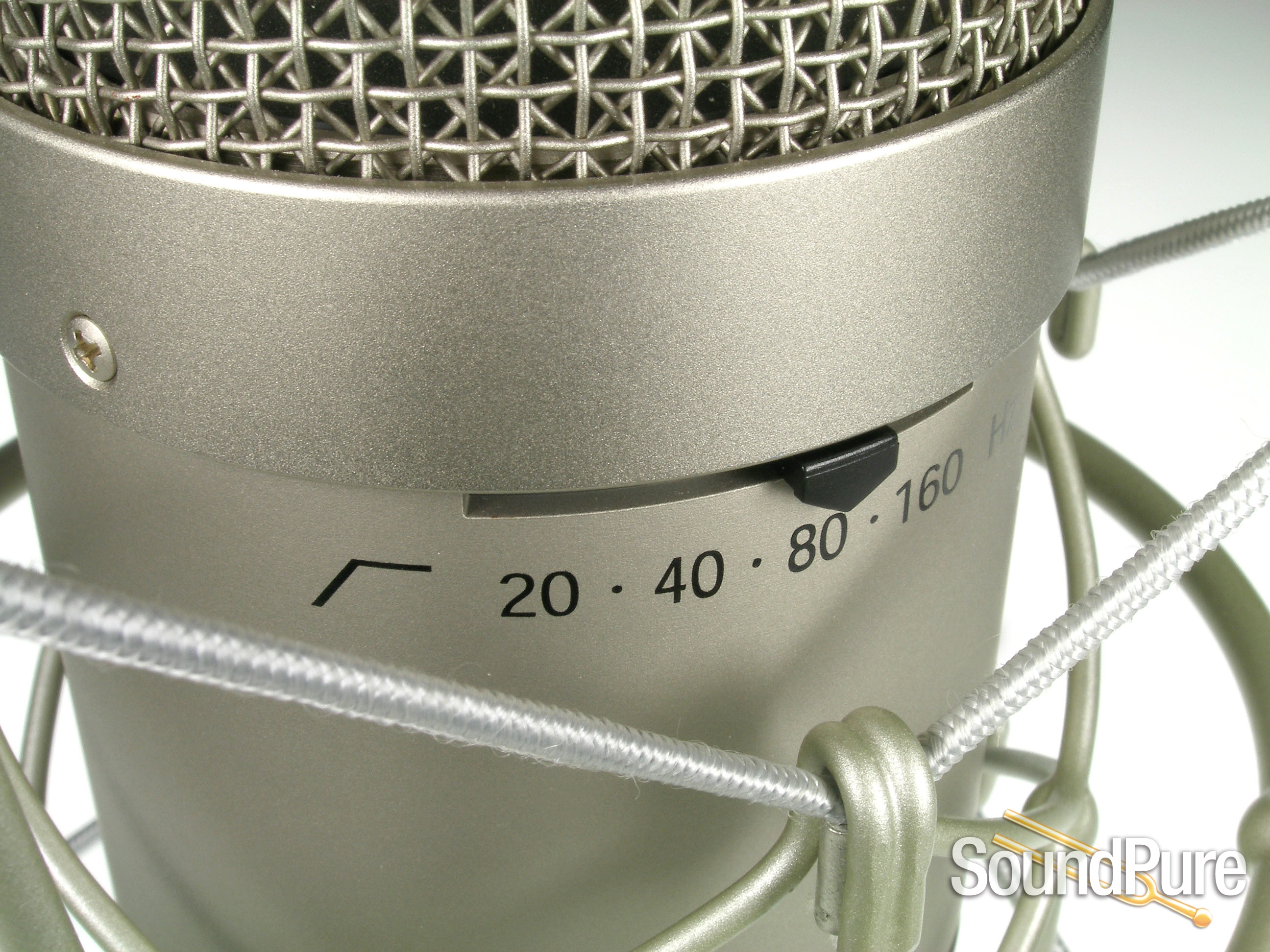
Two slide switches are located below the large, acoustically very open headgrille. The switch at the front allows selection one of nine directional patterns. The slide switch at the rear operates a seven-step high pass filter. It allows a very fine adjustment of the cut-off frequency.
Applications
There are nine polar patterns to choose from, making this microphone an ideal choice for a wide range of recording situations.
As its ancestors, the M 149 Tube is a superb vocalist microphone, not only because of the capsule, but also due to its modern circuitry, characterized by extremely low noise level.
Acoustic features
The M 149 Tube is addressed from the front, marked with the Neumann logo. Also on the front is the switch for the selection of the polar patterns.
The capsule is mounted elastically inside the headgrille to eliminate structure borne noise. The surface below the capsule is shaped like a cone to disperse any reflected sound from the acoustic upper half space. This avoids any interference with the primary sound arriving at the capsule directly.
A large headgrille surrounds the capsule. It is acoustically very open and therefore increases the sonic realism.
Polar patterns
The polar pattern switch selects one of nine directional patterns: omnidirectional, wide-angle-cardioid, cardioid, hypercardioid, figure-8, and one additional intermediate pattern between each major position.
Electrical features
The circuit of the M 149 Tube microphone has been developed to exceed traditional designs. We have selected a modern tube (triode) and combined its exceptional transmission characteristics with the advantages of our proven transformerless output circuit.
The aim was to provide a more controlled environment for the audio signal on its path from the capsule to the output section.
The final stage is an integrated amplifier, especially designed for such applications. It features very low distortion (THD < 0.002 % at ± 10 V), very low self-noise, and high output current capability.
As a result, the tube circuit is completely decoupled from the microphone output and its characteristic response curve will be unaffected by very high signal levels or varying load conditions.
The lower output impedance and higher output current capability allow cable lengths up to 300 m (1000 feet) without any degradation of the audio signal.
The tube amplifier changes the high impedance of the capsule and adds 10 dB of gain to the audio signal, providing optimum operating specifications. The wide dynamic range is impressive, as peak output can be ±10 V, at 20 mA.
The ideal operating point of the tube is maintained throughout its entire life expectancy. Plate current and filament voltage are constantly regulated. A sensor circuit monitors and compensates for any voltage drop across the microphone cable. The tube is heated up slowly through inverse current limiting to guarantee long life. Optimum operating conditions are reached within a very short time.
Filter
A seven-position slide switch is located on the back of the microphone. It selects a high-pass filter, advancing in half-octave steps between 20 Hz and 160 Hz (-3dB). This filter is useful to suppress rumble from air-conditioning and in windy situations.
In addition, the filter provides an effective tool to control the audio signal when the microphone is used at close distance and therefore proximity effect alters the program material.
Delivery Range
The specifically designed N 149 A power supply unit feeds the M 149 Tube through an 8-core cable. The output connector for the audio signal is a 3-pin XLR. The output signal is balanced.
The microphone comes as a set in an attractive aluminium case, together with the 8-core microphone connecting cable, the N 149 A power supply with plug-in mains unit, the EA 170 full elastic microphone suspension and a dust cover.
*The design of the microphone is a registered design of the Georg Neumann GmbH in certain countries.
|
Switchable tube microphone
|
|
Transformerless circuitry
|
|
High output level
|
|
Pressure gradient transducer with the M 49 capsule
|
|
Acoustically very open wire mesh cage
|
|
Nine directional characteristics: omni, wide angle cardioid, cardioid, hypercardioid, figure 8, and one intermediate position each
|
|
7fold switchable low frequency roll-off
|