

About Froggy Bottom Guitars
Michael Millard built the first Froggy Bottom Guitar in his lower east side apartment in 1970 during his first year as shop foreman at Gurian Guitars in NYC. The guitar was built for a friend, bluesman and singer/songwriter George Gritzbach. It was shaped like a Gurian Jumbo, with mahogany back and sides and a German spruce top. The building methodology was straight from the Gurian workshop of that era – classical free form without a mold to hold the shape, and a non-detachable Spanish-style neck. While shaped like a Gurian JM, the bracing was quite different from the Gurian approach in layout, proportion, curvature and height. It was his own.
For the next four years while working at the Gurian workshop, Michael continued to build guitars for individual friends, one at a time. Each person he built a guitar for had quite different descriptions of what their ideal instrument would be. Michael got to play and evaluate a great many guitars from the late 19th through mid 20th century, and to hear thousands of guitars of all quality levels in his own hands and in the hands of others.
What pleased one person might be the worst imaginable guitar for the next person and vice versa. After his second guitar it was clear that Michael had to build these instruments with detachable necks, and with each subsequent one, it became more clear that his biggest joy was found in figuring out the ideal match in instrument design for every musician seeking to own a Froggy Bottom guitar.
Guitars are about design, materials and proportion. In the beginning, almost everyone advised Michael to figure out what HIS guitar design should be and then to figure out how to produce that design efficiently. Fortunately for us, Michael was too stubborn to listen, and the list of friends and then friends of friends who asked for guitars kept him quite busy. There came a night in 1974 when he went to bed without an order for another guitar. While Michael had a hard time falling asleep that night, the phone woke him the next morning with an order for three guitars. Since then, we’ve never once gone to sleep at night without another guitar to work towards the following morning.
Understanding early on that he had an entire language of descriptive terminology to learn was both daunting and helpful. Frequently someone would say something like….. “I just LOVE this guitar, but why doesn’t it have any clarity as I play farther up the neck on the first two strings?” or “The bass in this is big and loud, but really muddy and unclear…” Each new project brought new desires, goals and LOTS of new descriptive language about what a specific player wanted in his/her new guitar. Without even seeing it happen, it became clear gradually that Michael’s work was going to involve making what others wanted out of their guitar, and NOT necessarily what he wanted to make. This made several things essential:
A methodology for building our instruments which was as completely flexible as possible, so that each and every part of each guitar could be varied around that players needs,
A commitment to a level of communication with our collaborators that allowed for talking thoroughly about the range of what is possible in steel string guitar design, and
A need to explore and source supplies of a wide variety of the very finest tone woods available from around the world.
While classical guitars are instruments developed through a single builder or family, with the concept being an ongoing long-term refinement of their design, steel string guitars have a family tree with more numerous branches. Think of all the variations you’ve seen or heard in guitars with steel strings! Tiny parlor guitars, huge jumbo guitars; 12 string, 7 string, 8 and 9 string guitars; high strung guitars, baritone guitars; guitars disguised as mando-cellos with eight strings in courses; guitars for rhythm, guitars for lead, harp guitars……. The list of possibilities goes on and on, and each player who knocked on my door had their own ideas about what would work for them, and why.
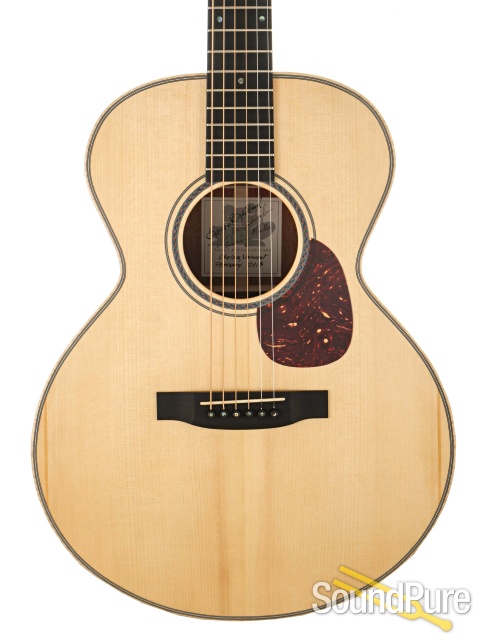
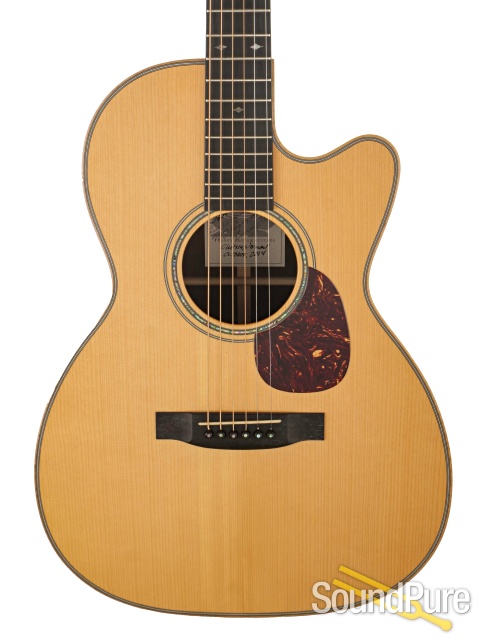
So our job has always been first to understand what would best serve the client and then to determine how to create that through design and available materials. Michael Millard never sought to re-invent the wheel; from thirty feet away a Froggy Bottom looks a lot like most traditional guitars of the last 120 years. The methodology we developed for Froggy Bottom, though, is where the difference lies. Given our ability to change literally every component in each of our guitars limits how many guitars we can make. This, in turn means there has to be a LOT of clear communication between guitar maker and player, and it means we must remain a small company.
After fifty years our guitars are still built one-at-a-time, with an overwhelming devotion to human craftsmanship. While we use modern CNC technology, it never imposes on the use of human skill and creativity.
Each guitar we make is created to a clear picture of what the intended result will be, by a tiny group of master craftspeople who play guitar themselves, seriously. Simply, we make tools for self-expression for people who are sincere about making music. They may be famous players whose names are household words or someone you will never hear of, but they share a desire to use the guitar which allows them the greatest possible range of expression in making the music they imagine.
We know we are not for everyone, but we also know that we are uniquely capable, for many guitarists, of building a guitar which they’ve only imagined is possible. In the first half of the 20th century the Packard Motorcar Company used the slogan ”Ask the man who owns one…..”. If you aren’t concerned with a guitar that looks like the newest device for intergalactic travel, but rather one that sounds better than you’ve ever dared imagine, and whose craftsmanship looks better and better the closer you look and is made of the finest woods on earth, you may want to explore this website very thoroughly and give us a call. We’d love to talk with you about what you’ve been looking for.