


From Schoeps Microphones
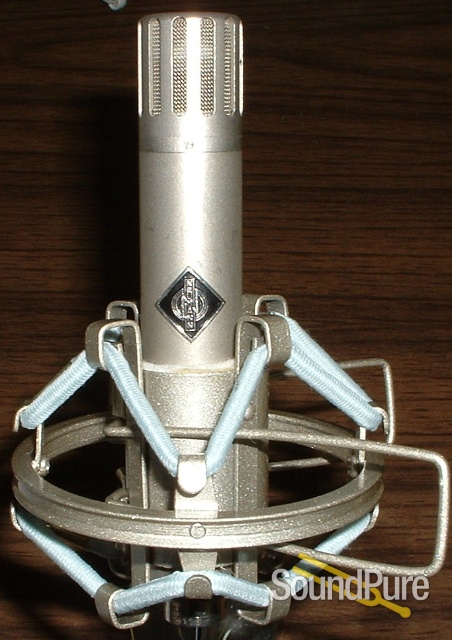
Although the CMC 5 Ug has a more modern successor (the CMC 6 Ug), some people place a special value on its discrete circuitry, or require an exact match for an existing microphone amplifier of this same type.
The CMC 5 Ug is designed exclusively for 48-Volt phantom powering.
The capsules of condenser microphones – the only type which SCHOEPS manufactures – cannot be connected directly to microphone cables or inputs; a microphone amplifier is required in between. Thus a complete microphone of the Colette series comprises any of the twenty-one available types of capsules combined with an amplifier.
The microphone amplifier provides the electrostatic charge which the capsule requires in order to produce a signal. Since only a miniscule amount of current is contained in this signal, amplification of the current is required. To avoid interference to the signal on the way from the microphone to the input of the mixer or preamp, the signal is conveyed at low impedance and in balanced form. CMC 5 Ug amplifiers offer a balanced, transformerless, direct-coupled Class A output stage with low impedance, low distortion, and high freedom from interference
Features:
- Predecessor of the CMC 6 Ug
- Made for P48 phantom powering
For installations in which 48-Volt powering will always be provided and in which RFI is not an issue, the model CMC 5 Ug is available.
Variant Amplifier Versions
Special versions of the CMC 5 Ug are available with different gain (amplification factor) or extended low-frequency range. Either type of amplifier can be specially ordered, or retrofitted at the factory, to have a different low-frequency limit from the standard version (see, for example, the ”linear” version listed below).
CMC 5 Ug Linear
The CMC 5 Ug microphone amplifier normally has a gradual rolloff in response below 30 Hz to guard against infrasonic disturbances from various sources such as air movement and vibration. However, when using pressure (omnidirectional) transducers, particularly with digital recording, it can be desirable to pick up frequencies below 20 Hz without attenuation. The special technology of the CMC 5 Ug linear microphone amplifiers makes this possible; on request we can deliver microphone amplifiers with response that is flat to as low as 3 Hz.
Caution must be advised with respect to infrasonics, however. Since pressure transducers can pick up very low frequencies, ventilation systems in large spaces (churches, concert halls) or traffic rumble can create a problem. With pressure gradient transducers the risk is even greater. They are far less sensitive to very low frequency sound, but respond much more strongly to low-frequency mechanical stimuli such as air currents and solid-borne noise. Such signals may be below the audible range of frequencies, but they can overload electronic circuitry and produce severe distortion, particularly in transformer-coupled circuitry.
CMC 5 Ug +5 dB
The sensitivity of a microphone using this type of amplifier is 5 dB higher than with the standard version, but the equivalent noise level and maximum output voltage are not materially affected. Thus the highest sound pressure level which the microphone can accept without distortion is 5 dB lower than in the standard version, while the signal-to-noise ratio is essentially the same with either gain setting.
This version might be chosen in order to raise the microphone's signals above the noise level of the equipment to which it will be connected, and / or for working with sounds that occur mainly at low levels
MK41 Super Cardioid Capsule
Overview
Supercardioid with highly consistent directionality throughout its frequency range
For music and speech
High directivity, comparable to that of a short “shotgun“ microphone up through midrange frequencies
Often preferred for use in film sound recording and as a spot microphone in orchestras
The MK 41 is strongly directional. Sound arriving from off axis is attenuated even more than with a cardioid. The pickup is “drier” and less susceptible to acoustic feedback than any other SCHOEPS capsule type (a loudspeaker should not be located directly along the rear axis of the microphone, however).
Application
Its directivity is highly independent of frequency, so that even sounds arriving off axis and reverberant sound are registered without coloration. Consequently, even distant placement of the capsule produces a very natural sound pickup. This is a real advantage over interference-tube “shotgun” microphones, whose directivity is very frequency-dependent – exceeding that of a supercardioid only at higher frequencies. Interference-tube microphones are notoriously sensitive to their position in a room, where the shifting patterns of reflections cause corresponding shifts in sound color. Thus the MK 41 are surprisingly effective, space-saving alternatives to shotgun microphones – and being small, they can often be placed closer to the sound source. (Regarding shotgun microphones, see CMIT 5 U.)
An M/S microphone arrangement can be set up at quite some distance from the sound source if an MK 41 is used for the “M“ channel.
Compared to the cardioid MK 4, the MK 41 has slightly more rolloff at the low end due to the gradient effect. Its diffuse field response elevation is less than that of the MK 4.
| Powering voltage | 48 V |
|---|---|
| Current consumption | 4 mA |
| Impedance | 35 Ω |
| Low-cut frequency | 30 Hz |
| Maximum output voltage | 1 V |
| Minimum recommended load impedance | 600 Ω |
| Length | 113 mm |
| Diameter | 20 mm |
| Weight | 63 g |
| Surface finish | matte gray (g) or nickel (ni) |
MK41 Capsule
- Frequency range
- 40 Hz - 20 kHz
- Sensitivity
- 14 mV/Pa
- Equivalent noise level (A-weighted)
- 15 dB-A
- Equivalent noise level (CCIR)
- 24 dB
- Signal-to-noise ratio (A-weighted)
- 79 dB-A
- Maximum sound pressure level at 0.5% THD
- 132 dB-SPL
- Length
- 22 mm
- Diameter
- 20 mm
- Weight
- 17 g
- Surface finish
- matte gray (g) or nickel (ni)
You may also like
Browse Small Diaphragm Condensers →

Sound Pure Studios · Durham, NC
Come hear it in our control rooms.
Sound Pure is a working studio in Durham, NC — a 1,000 sq ft live room and two pro control rooms. Book a session to audition gear in a world-class acoustic space before you buy.