


From HEDD
The Dedicated Extension Module.
The TYPE 40 XTD is a dedicated active low-frequency extension module for the TYPE 40 Main. Depending on its configuration, it increases low-frequency headroom and output, provides cardioid control over rearward bass radiation, or combines both. The Main remains a complete full-range reference, while the XTD gives engineers greater control over how the system performs in their room. The XTD is designed for use with the TYPE 40 Main and is not a standalone product.
With one to three XTD modules per channel, studios can tailor the configuration to their acoustic and playback requirements, then expand the system as those needs change.
Each XTD combines a 10¾-inch high-excursion woofer with a dedicated 700 W Class D amplifier. Four different operating modes combine Frontfire or Cardioid operation with a Ported or Closed enclosure, all integrated with the Main through HEDD Lineariser® and HEDD CTRL.
Key features
Cardioid bass control
In Cardioid mode, the XTD works with the Main or Frontfire XTD modules to reduce low-frequency energy behind the system by up to approximately 10 dB. This helps limit reflections from the wall behind the monitors that can blur the low end. One Cardioid Closed XTD with a full-range Main provides directional control from approximately 20 to 200 Hz. Cardioid Closed offers the widest frequency range of rear reduction. Cardioid Ported, used with Frontfire Ported modules in mixed configurations, covers a somewhat narrower range while retaining the efficiency of a ported system. Larger mixed configurations combine Frontfire output with Cardioid control, with performance determined by the arrangement and operating modes. For Cardioid operation, the XTD is also physically reversed to fire towards the rear.
Configurations and output
Choose one to three XTD modules per channel according to the room’s acoustic behaviour, listening distance, and output requirements. Each XTD can be configured with either a Ported or Closed enclosure.
For maximum output, all XTDs can operate in Frontfire Ported mode, increasing maximum SPL at 50 Hz by 6, 12, or 15 dB with one, two, or three modules respectively, relative to the Main alone. Mixed Frontfire/Cardioid configurations balance output needs with rear-radiation control. The Main remains at the reference monitor in every configuration, allowing the system to expand as requirements change.
Ported or Closed
Ported operation provides greater efficiency and maximum low-frequency output. Fitting the supplied sealing panel converts the XTD to a Closed enclosure, trading some maximum output for more controlled low-frequency reproduction. The matching Closed or Ported (CoP) setting is selected in HEDD CTRL or on the back panel.
HEDD Lineariser®
In ZERO PHASE mode, HEDD Lineariser® corrects amplitude and phase response and time-aligns the Main and XTD modules. FLAT mode corrects frequency response without phase linearisation, while OFF provides the lowest possible latency for tracking and real-time performance. The same Lineariser mode is used across every unit in the system.
HEDD CTRL
HEDD CTRL manages the Main and XTD modules from the listening position. Once the units are assigned and their operating modes selected to match the physical setup, the software automatically applies the correct LF Range and Extension Qty settings. Engineers can then manually correct the room using 12-band parametric EQ at group and individual-speaker level, with presets for different workflows or listening positions. The free software supports systems of up to 250 speakers.
Installation and connectivity
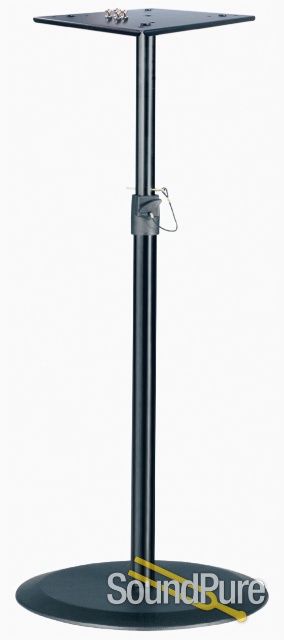
The XTD matches the Main’s cabinet dimensions and can be stacked vertically either above or below the Main. Balanced analog XLR and AES/EBU inputs with Through connections allow audio to be routed between units. The recommended Sound Anchors HEDD TYPE 40 System Stand is available separately; alternative supports must maintain the correct physical alignment for the selected operating mode.
Features
- Dedicated active low-frequency extension for the TYPE 40 Main; one to three XTD modules per channel
- Cardioid rear-radiation reduction of up to approximately 10 dB, depending on mode and configuration
- 10¾-inch high-excursion woofer with dedicated 700 W Class D amplification
- Four operating modes: Frontfire Ported, Frontfire Closed, Cardioid Ported, and Cardioid Closed; sealing panel supplied for Closed operation
- Frequency response (-3 dB): 20–80 Hz, extending to 20–250 Hz in Cardioid operation with the Main
- Maximum SPL gain at 50 Hz with all XTDs in Frontfire Ported mode: +6 dB (one), +12 dB (two), or +15 dB (three) per channel, relative to the Main alone
- HEDD Lineariser® with ZERO PHASE, FLAT, and OFF modes
- HEDD CTRL over Ethernet with automatic LF Range and Extension Qty settings; 12-band PEQ for manual room correction at group and individual-speaker level, plus presets and firmware management
- Balanced analog XLR and AES/EBU digital inputs, both with Through connections
- Matching cabinet dimensions with the Main; side M10 mounting points; recommended system stand available separately
| Specification | TYPE 40 XTD |
|---|---|
| Type | Dedicated active low-frequency extension module for the TYPE 40 Main |
| System configuration | One TYPE 40 Main plus one to three TYPE 40 XTD modules per channel |
| Driver | 10¾-inch Ultra-High Performance Subwoofer |
| Amplification | Class D, 700 W |
| Operating modes | Frontfire Ported / Frontfire Closed / Cardioid Ported / Cardioid Closed |
| Acoustic principle | Selectable Ported or Closed; aluminium sealing panel supplied |
| Mode selection | CoP control or HEDD CTRL; physical orientation and port state must match the selected mode |
| Frequency response (-3 dB) | 20 Hz–80 Hz; extends to 20 Hz–250 Hz in Cardioid operation with the TYPE 40 Main |
| Frontfire crossover | 80 Hz with the TYPE 40 Main in XTD mode |
| Maximum SPL gain at 50 Hz All Frontfire Ported | +6 dB (1 XTD) / +12 dB (2 XTDs) / +15 dB (3 XTDs) per channel, relative to the Main alone |
| Maximum SPL gain at 50 Hz All Frontfire Closed | No increase (1 XTD) / +6 dB (2 XTDs) / +9 dB (3 XTDs) per channel, relative to the Main alone |
| Cardioid rear reduction | Up to approximately 10 dB in the rear hemisphere; effective frequency range varies by mode and configuration |
| Single-XTD Cardioid range | Approximately 20 Hz–200 Hz with one Cardioid Closed XTD and the Main in FULLRANGE |
| Mixed-system Cardioid range | Approximately 20 Hz–100 Hz in mixed Frontfire/Cardioid configurations |
| Self-noise at 10 cm | <20 dB SPL, A-weighted |
| DSP integration | Internal processing at 96 kHz; HEDD Lineariser® with ZERO PHASE, FLAT, and OFF modes |
| Lineariser delay | 2.3 ms OFF / 2.3 ms FLAT / 11.3 ms ZERO PHASE |
| Analog input | Balanced XLR with Through; input impedance >20 kΩ |
| Digital input | AES/EBU XLR with Through; accepted sample rates 44.1–192 kHz |
| Maximum input level | +14.77 dBu at -4 dB input sensitivity |
| Input gain / sensitivity | -10 / -4 / 0 / +4 dB |
| Shelving filter | Adjustable level; corner frequency 40 / 80 / 120 / 160 / 200 Hz |
| Extension Qty | 1 / 2 / 3; setting depends on the unit’s role in the configuration |
| Control / management | HEDD CTRL via Ethernet / RJ45; 12-band PEQ at group and individual-speaker level |
| Automatic standby | After 30 minutes of inactivity by default; timing adjustable in HEDD CTRL |
| Power supply | 85–264 V, 50/60 Hz |
| Power consumption | 20 W idle / 588 W full output / <0.5 W standby |
| Cabinet / finish | MDF / satin black matte paint |
| Mounting | Side M10 points; mounting hardware sold separately |
| Recommended stand | Sound Anchors HEDD TYPE 40 System Stand, sold separately |
| Dimensions (H × W × D) | 370 × 470 × 450 mm |
| Weight | 27.5 kg per unit, plus 1.5 kg aluminium sealing panel |
Free 3-Year Warranty
In addition to the standard included manufacturer warranty, virtually all new products carry our exclusive, industry-leading, absolutely free Sound Pure 3-Year Warranty, which includes parts and labor. It's our way of adding real value to the personal touch our small, dedicated team brings to every purchase.
Coverage exclusions live in Terms & Conditions, Section 27. Read the warranty →
You may also like
Browse Studio Monitors →


Recommended accessories


Sound Pure Studios · Durham, NC
Come hear it in our control rooms.
Sound Pure is a working studio in Durham, NC — a 1,000 sq ft live room and two pro control rooms. Book a session to audition gear in a world-class acoustic space before you buy.