


Sound Pure's Take
The AEA TRP (The Ribbon Pre) is a purpose-built, two-channel discrete JFET microphone preamplifier engineered in Pasadena, California specifically to unlock the full sonic potential of passive ribbon and low-output dynamic microphones. Designed by ribbon microphone authority Wes Dooley and the Audio Engineering Associates team, the TRP addresses the core electrical mismatches that hold classic ribbons back on standard console preamps—delivering up to $+85\text{ dB}$ of ultra-quiet, DC-coupled gain alongside a high input impedance that lets delicate ribbon motors breathe freely without damping their transient response or rolling off their low end.
What makes the TRP indispensable in studios tracking with vintage RCA 44s, Coles 4038s, Royer R-121s, or Shure SM7Bs is its combination of massive, clean headroom and minimalist signal purity. By eliminating input transformers, coupling capacitors, and $+48\text{V}$ phantom power circuitry from the signal path (with later TRP2/TRP3 revisions adding selectable phantom power for active ribbons and condensers), the TRP preserves lightning-fast transient detail, deep sub-bass extension, and an effortless, open top end that brings passive ribbons to life without added hiss or coloration.
The AEA TRP is the benchmark preamplifier for getting the absolute best out of passive ribbon and dynamic microphones. By combining extreme quietness, high-impedance transducer freedom, and $+85\text{ dB}$ of pristine JFET gain, it turns any passive ribbon into an effortless, high-headroom studio centerpiece.
The videos below demonstrate the AEA TRP preamplifier paired with passive ribbon microphones on vocals, acoustic instruments, and studio comparisons.
From AEA
The AEA Ribbon Mic Preamplifier is an ultra high-gain and impedance, minimal-path FET mic pre designed by Fred Forssell. This low-noise two-channel preamp is for ribbon, moving coil, and tube microphones that do not use or want phantom power. This allows for improvements in minimal path circuitry and also rids the unit of phantom-power blocking capacitors. Zener diodes on the input protect the input stage if external phantom power is applied.
First stage gain is set from +6 to +63 dB by a 12 position Grayhill switch. Another 20dB of gain is available after the output level potentiometer. Polarity reversal and high pass switches on the two channels are complimented by operating and overload LED metering.
83 dB of gain
130 EIN noise figure
3 dB at 300 kH
No phantom power, 18,000 ohms input impedance
Green and Red LEDs indicates channel level
Balanced XLR +4, and Unbalanced 1/4 inch -10 outputs
- External Features
- Switched Gain and Continuous Level Controls
Phase reverse and high-pass switches
Anodized gray and black matte finished aluminum
Laser engraved legends and single line schematic
External power supply for minimum noise
- Dimensions
- Half-rack wide, one rack unit high (8.5" x 8.5" x 1.7")
- Weight
- Two pounds, plus power supply is (1.5 lbs.)
You may also like
Browse Stereo Mic Preamps →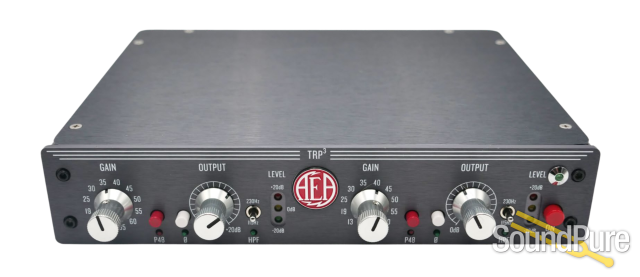

Recommended accessories

Sound Pure Studios · Durham, NC
Come hear it in our control rooms.
Sound Pure is a working studio in Durham, NC — a 1,000 sq ft live room and two pro control rooms. Book a session to audition gear in a world-class acoustic space before you buy.