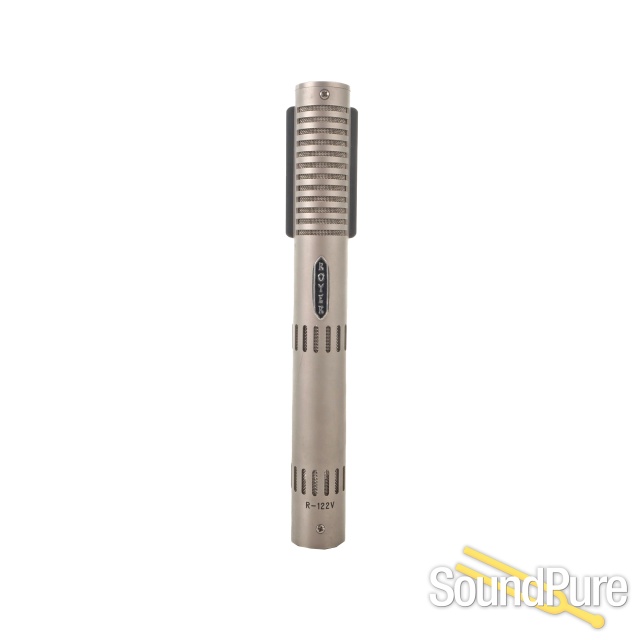
The R-122 is the world's first phantom powered, active ribbon™ microphone. Its unique electronics package gives the R-122 greater output than standard, non-powered ribbons, and places a perfect impedance load on the ribbon element, greatly expanding the number of preamps the mic operates well with.
Before the R-122, all ribbon microphones were passive devices. Tracking strings, acoustic guitars, vocals and other quieter sound sources required pre's with a lot of gain and a high input impedance. With the R-122, gain and impedance issues are a thing of the past, letting you use more pre's with great results.
Conventional ribbon microphones need high-quality, high-gain microphone preamplifiers to record softer sound sources. The R-122 is as sensitive as a condenser microphone, allowing you to use practically any mic preamplifier or board pre's to record even the quietest sounds. The R-122 contains a fully balanced, discrete head amplifier system utilizing a specially wound toroidal transformer and ultra-low noise FET's. This system is extremely quiet, can handle 135 dB SPL, and brings the R-122's sensitivity to 37 dB! Go ahead and plug an R-122 into any preamp with average gain - you'll get full Royer performance and enough level to drive any recording medium.
The R-122's higher sensitivity does not create additional self-noise. All of the R-122's increased sensitivity comes from its large, specially wound toroidal transformer - that wonderful thing called "free gain." The phantom powered circuitry provides impedance conversion only, adding no noise of its own.
The R-122 is every bit as tough as our R-121. It is a first-call mic for electric and acoustic guitars, drum overheads, brass, percussion, electric and acoustic bass, piano, strings, woodwinds, Foley, and many other applications.
The R-122 is similar to the R-121, but the faster transient response and larger size of the R-122's audio transformer translates into more open highs and a tighter, more focused low end response. Because of the faster transient response and tighter low end, engineers often choose them over R-121's for drum overheads, acoustic instruments and vocals. R-121's tend to edge out R-122's on electric guitars and brass, but it's a matter of taste. If you're recording mostly electric guitars and/or brass, we usually suggest going with the R-121. The R-122 is just as good on these instruments, but you may not need (or want) the additional top-end openness (from the faster transient response) and you certainly won't need the R-122s higher sensitivity on these high SPL applications. If you plan on using the mics primarily for drum overheads, vocals, piano, acoustic instruments, strings, classical music applications and so forth, we heartily recommend going with the R-122.
The R-122's active electronics put a perfect load on the ribbon element at all times, allowing the R-122 to deliver 100% of its full sonic potential regardless of the input characteristics of the following mic pre. Due to its low-impedance output, R-122's can be used on extremely long cable runs with minimal signal loss. In addition, the ribbon element can't be damaged by phantom power, miswired cables or electrical glitches.
The R-122's proprietary offset ribbon transducer (Patent # 6,434,252) is the first of its kind, positioning the ribbon element closer to the front (logo) side of the microphone. This arrangement gives the ribbon more room to move within the prime magnetic field while maintaining full frequency response during high SPL recordings. Also due to this offset ribbon transducer, the back of the R-122 records slightly brighter than the front side at distances of three feet and closer. This can be extremely useful for recording acoustic guitars, vocals, drum overheads and other sound sources that you may want a slightly brighter response on. It's an integral piece of the magic of all Royer R-series microphones.
As with all Royers, pushing up the faders on your ribbon-recorded tracks at mixdown is a revelation. When your tracks sound natural and real, there's nothing to fight and they fit into the mix easily.
Features
-
Phantom powered circuitry provides high output and impedance matching
-
High SPL Capabilities
-
No distortion up to maximum SPL rating
-
Extremely low residual noise
-
Ribbon element is not affected by heat or humidity
-
Absence of high frequency phase distortion
-
Equal sensitivity from front or back of element
-
Consistent frequency response regardless of distance
-
Rear side of mic records slightly brighter when three feet or closer to sound source
Applications