-
Call Us Toll Free888-528-9703
-
Local/International (+1)919-682-5552
$219.00
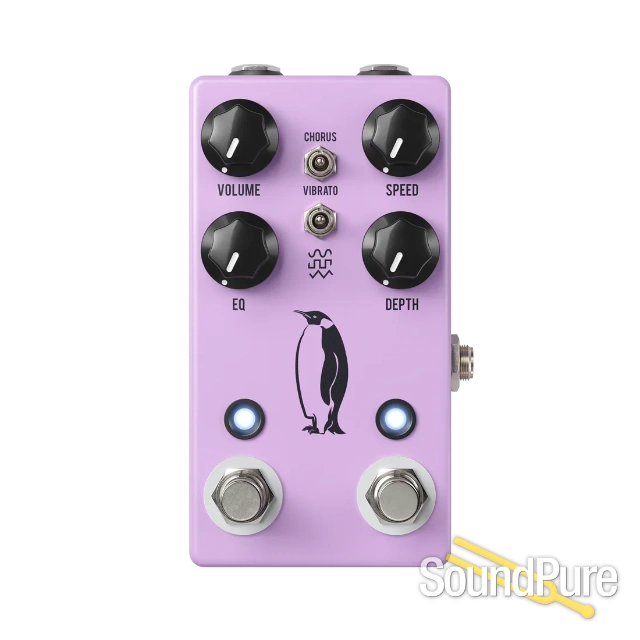
The JHS Unicorn V2 is a beautifully authentic Uni-Vibe and vibrato pedal that captures the swirling, hypnotic motion of the original photocell-driven designs players still chase today. Its fully analog, bulb-based circuit delivers organic throb, chewy pulse, and rich movement that feels alive under your fingers. Tap tempo, rhythmic ratio control, and expression support make it surprisingly flexible without losing vintage character. Whether set for subtle shimmer or deep, psychedelic swirl, the Unicorn V2 feels musical, inspiring, and thoughtfully built—a timeless modulation tool and a smart long-term investment for players who value feel, nuance, and true analog motion.
In 2015 we brought you the Unicorn V1, the world's first bulb-driven photocell modulator with tap tempo, the JHS Uni-Vibe. As of Spring 2018, we are proud to bring you the Unicorn V2!
Pink Floyd’s “Breathe,” Jimi Hendrix’s live Woodstock performance of “The Star-Spangled Banner,” and Robin Trower’s “Bridge of Sighs” cemented the sound of a photocell-based vibe effect as an electric guitar standard. The JHS Pedals Unicorn is our version of this heralded effect, continuing the inspiring modulation/phasing/rotary sounds that never fail to push musical boundaries. And just like the originals, we included a toggle for choosing between a Uni-Vibe* effect and a traditional vibrato setting. What sets Unicorn apart from all other vibe-style circuits is that it is the first-ever fully analog, photocell-based vibe with tap tempo as well as ratio, external tap control, and external rate control via expression pedal (optional). And the Unicorn does it all with only four knobs and a mini-toggle switch. In a day and age when everything has been seen and done, we bring you the first-ever, 100% analog vibe photocell modulator with onboard tap tempo. You’re welcome.
SOUNDS AS GOOD AS YOU REMEMBER
The Unicorn is bursting with all the lush and washy pulsations that changed what the electric guitar could sound like in the 1960s. And this is no digital emulation. The Unicorn sports the real-deal, analog photocell topology of the original units.
- Sounds like the original because it’s built like the original
- All-analog signal path delivers a warm, touch-sensitive tone
- Dry/Wet toggle selects between a Uni-Vibe* and vibrato effect
IN-DEPTH TEMPO CONTROL
There are other analog vibe pedals and there are pedals with tap-tempo control, but-- if you’ll indulge us in a brief humble brag --the JHS Unicorn is the first to put ‘em together. Add optional external speed control and a ratio knob that determines the rhythmic subdivisions (or as we like to say, how much fairy dust enters into the flux capacitor of the Unicorn) and you have one of the most versatile vibe pedals on the market.
- Control the rate of the effect with the Speed knob or onboard tap-tempo footswitch
- Want quarter note, dotted eighth, or triplet rhythms? They’re all found on the Ratio knob
- LED indicator notifies you of the effect’s tempo, even when disengaged
EXTERNAL TEMPO AND EXPRESSION CONTROL
But wait, there’s more! One of the things that makes the vintage Shin-ei* Uni-Vibes* so desirable is your ability to control the effect’s rate in real time with an external expression pedal. How could we not include that!? And to go one step further, you can slave the pedal to other tap-controlled pedals for rhythmic consistency across all your effects.
- Internal Tap/Expression mini switch controls the side-mounted Tap/Exp TRS jack
- Expression pedal control of the Unicorn’s rate in the Exp setting
- Use an external source to control the rate in the Tap Out setting (which coincidentally works great with our Panther Cub Delay and Emperor Chorus pedals)
COULDN’T BE EASIER TO USE
One of the things we’re most proud of with the Unicorn Uni-vibe* Photocell Modulator is how easy it is to dial up the exact pulse of a mystical Unicorn running across a field of 4-leaf clovers…but only if you dare.
- Four knobs and a mini toggle are all you need for a world of syrupy, modulated tones
- Left two controls are your tone, right two controls are your speed, toggle is your effect. It’s that simple.
2007
Sometime in early 2007, Josh fixes his BOSS BD-2 Blues Driver by replacing a footswitch that isn't activating properly. Because of this, he becomes super interested in how pedals work and in their circuitry.
Around April 2007, Josh begins to modify his friends' pedals and decides to start selling modified BOSS pedals under the name JHS Mods. These pedals are sold at his friend's local guitar shop, Fondren Guitar, in the Fondren area of Jackson, MS. The first modified pedals ever sold are the Lexi Drive (modified DS-1) and Blu Drive (modified Blues Driver). These early units have a simple black label with a green JHS Mods logo and are all modified in a small upstairs attic room on a folding card table.
2008
Josh begins learning to build his favorite pedals from scratch, leading to original JHS pedal ideas and designs. The earliest JHS releases include the Pulp 'N' Peel, the All American and the Morning Glory. The Morning Glory is created by reinventing his favorite Marshall Bluesbreaker pedal.
Sometime in mid-2008, the name JHS Mods is replaced by JHS Pedals to reflect the more diverse product line that now includes modifications and custom pedals.
Josh builds a DIY website, causing more online growth and providing a wider reach than his local customer base, which is also growing.
Every pedal from 2008 is still being built in Josh's spare room on a folding card table.
2009
In the summer of 2009, Josh relocates from Jackson, MS, to Tupelo, MS. He repurposes his brother-in-law's small backyard tool shed, transforming it into a functional work area. Almost immediately, he installs a window AC unit to combat the scorching 100+ degree Mississippi summer days. It is in this shed that the Double Barrel, Sweet Tea and numerous other designs take their initial form.
This becomes the focal point of Josh's first press interest when a newspaper article showcases the shop's distinctive pink walls, which are actually insulation sheets Josh and his dad used to retain cold air. Consequently, the shop earns the moniker "The Pink Palace" among friends and local guitarists who frequent the space.
During this period, Josh also introduces his original designs to the public by selling them at Mainstreet Music, a guitar shop in Tupelo. Furthermore, Josh collaborates with Drew Shirley of Switchfoot to launch the BunRunner fuzz pedal. This collaboration propels the company into a faster trajectory of growth and notoriety, attracting the support of many major artists.
In the fall of 2009, the JHS shop makes another move, this time to Josh's father-in-law's backyard workshop in Ecru, MS. It is from this location that the Mini Foot Fuzz, Pollinator and various other designs are first crafted and sold.
In December of 2009, Josh relocates to Kansas City, MO, driven by the escalating demand for his products. Recognizing the need for assistance, he brings in Nick Loux, the original JHS employee, and his lifelong friend Khaleed to join him in the endeavor of building guitar pedals.
The unfinished basement of their new Kansas City home undergoes a transformation into a fully equipped JHS shop, where up to six employees work side by side to craft pedals. As demands continue to grow, Josh and the team eventually make the transition to JHS’s first official commercial location, situated off Main Street in Grandview, MO.
2011
The Grassroots Dealer Campaign is initiated in the summer of 2011, marking JHS's proactive efforts to establish B2B dealer relationships. In a remarkable span of approximately thirty days, JHS experiences substantial growth, expanding from 5 to 50 retailers.
2012
Josh Scott embarks on a collaboration with the Chicago Music Exchange to create his own guitar pedal demos. This collaboration marks one of the pioneering instances of a pedal manufacturer partnering with a retailer to produce demo video series within the industry.
2013
JHS introduces a teaser video for the Moonshine Overdrive, marking the inception of the JHS Teaser Video Series and initiating a trend within the industry for this form of marketing.
In September 2013, JHS Pedals is selected for Premier Guitar magazine's Pedal Builder Profile, representing the most significant press coverage for JHS up to that point.
2014
JHS makes its debut at the Winter NAMM Show in Anaheim, CA, marking a significant milestone for the company. At the show, they unveil the Colour Box V1, a pedal that represents a groundbreaking innovation and a departure from the conventional pedal norms.
2015
Josh and Robert Keeley collaborate on a pedal and release the Steak and Eggs Overdrive/Compressor, marking an industry first for two competing boutique pedal companies to collaborate on a major scale.
The Muffuletta teaser video is recorded during a brief 2.5-hour trip to New Orleans, and the product is released on September 15, 2015. The Muffuletta format represents a first for JHS, establishing a multi-pedal format with perfect analog replication of vintage/rare pedals instead of digital emulation.
In November 2015, JHS partners with Andy Timmons on the AT "@” Artist Pedal, which is subsequently released.
2016
JHS makes a groundbreaking announcement by introducing possibly the two most requested nonexistent guitar pedals of all time, namely the Bulb and the See Saw. Witnessing it is a must to truly believe it!
Additionally, JHS ventures into the realm of pro audio with the debut of the JHS 500 Series.
2017
Josh and Nick Loux embark on a collaborative journey, creating multiple video series, including “Combos,” “That Sounds Neat” and “Hot Trax,” which serve as early precursors to The JHS Show. Some of the most intriguing and enjoyable content arises from experimenting with and promoting other pedal companies' pedals instead of their own JHS gear.
Simultaneously, Josh delves into teaching guitar history at public events, leading him to realize that he might derive more enjoyment from this than making pedals. The jury's still out on this intriguing revelation.
On September 8th, the BOSS JB-2 Angry Driver is released, a pedal resulting from a collaboration between JHS and Boss to celebrate Boss's 40th anniversary. This is a significant honor for JHS Pedals.
2018
Following the same format as the Muffuletta, the Bonsai makes its debut at the January 2018 NAMM Show and promptly becomes the most successful JHS release up to that point.
On May 31st, Josh and Nick release the first episode of The JHS Show, marking the beginning of a new venture for JHS in the realm of content creation.
2020 + COVID
In a collaboration with Paul Gilbert, JHS introduces the PG-14 Paul Gilbert Artist Signature Pedal at the January 2020 NAMM Show.
In March 2020, the COVID-19 pandemic emerges, prompting JHS to swiftly adapt to the "new normal" by implementing safety measures for builders to socially distance in the shop and encouraging as many employees as possible to work from home.
Despite the challenges posed by COVID-19, on May 15th, 2020, JHS releases the Legends of Fuzz pedal series.
On October 2nd, 2020, JHS launches the 3 Series of pedals, further expanding their product lineup.
Product Type: Uni-Vibe / Vibrato Modulation Pedal
Model: JHS Pedals Unicorn V2
Circuit Type: 100% Analog
Modulation Topology: Photocell-Based (Bulb-Driven)
Effects:
Uni-Vibe
Vibrato
Effect Switching:
Mini Toggle (Dry/Wet toggle selecting Uni-Vibe or Vibrato)
Controls:
Four Knobs
Two Tone Controls (left side)
Two Speed Controls (right side)
Mini Toggle Switch (effect selection)
Tempo Control:
Speed Knob
Onboard Tap-Tempo Footswitch
Ratio Control:
Ratio Knob for rhythmic subdivisions
Quarter Notes
Dotted Eighths
Triplets
External Control:
External Expression Pedal Support (Rate Control)
External Tap Tempo Support
Tap / Expression Features:
Internal Tap/Expression Mini Switch
Side-Mounted Tap/Exp TRS Jack
Tap Out Mode for syncing to other tap-tempo pedals
Tempo Indicator:
LED Indicator (Active Even When Effect Is Disengaged)
Signal Path:
Fully Analog
No Digital Emulation
THIS PEDAL REQUIRES STANDARD 9V DC CENTER NEGATIVE POWER, CONSUMES 100MA, AND MEASURES 2.2” X 4.8" X 1.6".
Payments as low as $19/mo.