
Sound Pure's Take
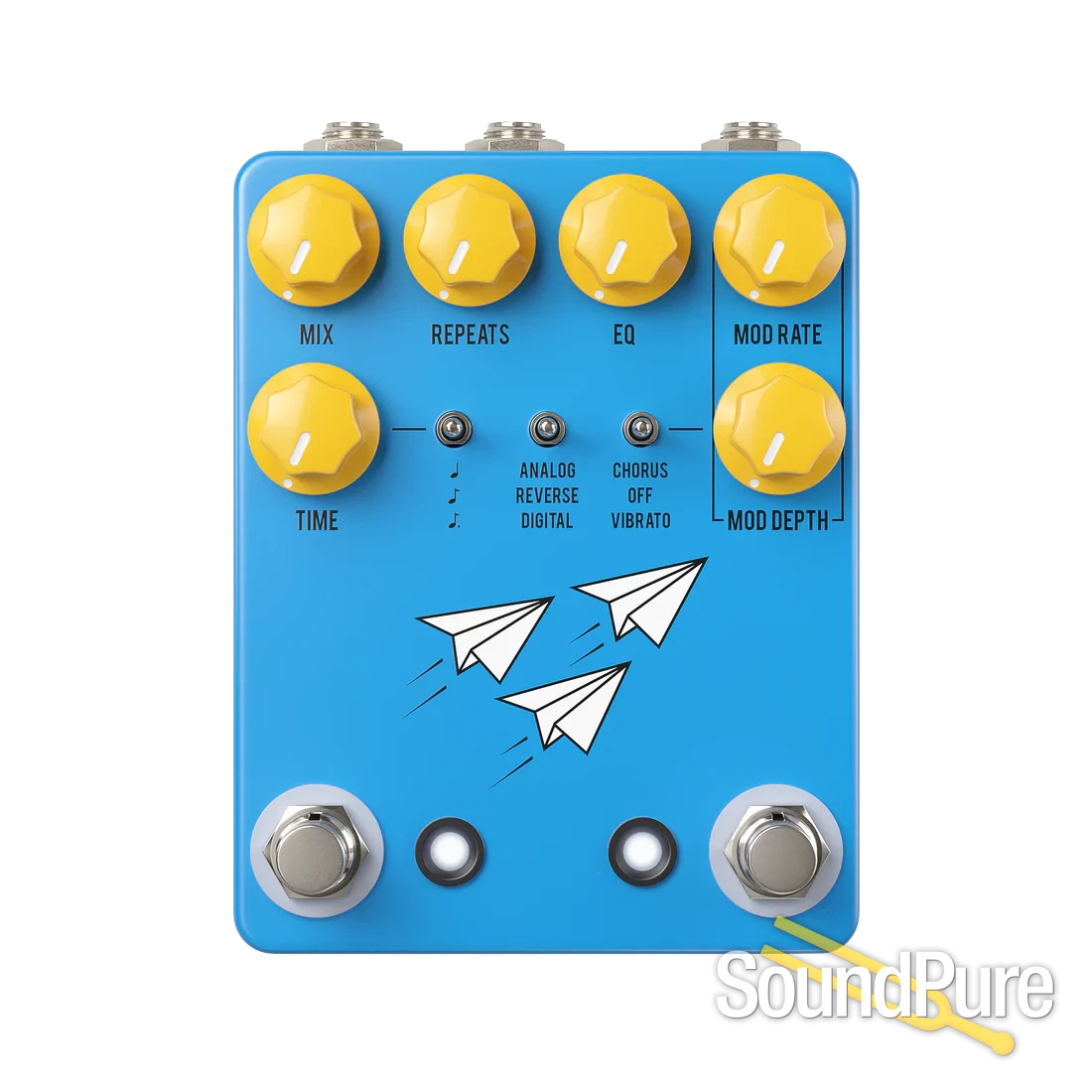
The JHS Flight Delay is a thoughtfully designed, no-nonsense delay pedal that delivers inspiring sounds without menus or distractions. With analog, digital, and reverse modes on tap, it covers everything from warm, memory-man style repeats to crisp modern echoes and atmospheric reverse textures. Intuitive controls make dialing in tones fast and musical, while tap tempo, subdivisions, and optional modulation add depth and movement when you want it. Compact, flexible, and easy to live with, the Flight Delay feels like a dependable creative partner and a smart long-term investment for players who value tone, simplicity, and inspiration.
From JHS Pedals
The JHS Pedals Flight Delay was made with one goal in mind: to be everything you need in a delay and nothing you don’t. In a world full of complex effects pedals, we worked hard to bring you the opposite - a beautifully simple stompbox that combines the most essential delay types with the features that matter. With three modes (Analog, Reverse, and Digital) inspired by my all-time favorite delays - EHX Memory Man, Boss DD-5, and Line 6 DL4 “Reverse Mode” - the Flight Delay is familiar, inspiring, and versatile enough for players in any genre. If you are tired of delay pedals that require frustrating menu diving to find the sound you want, endless scrolling on option screens, and complicated user interfaces, look no further!
CONTROLS
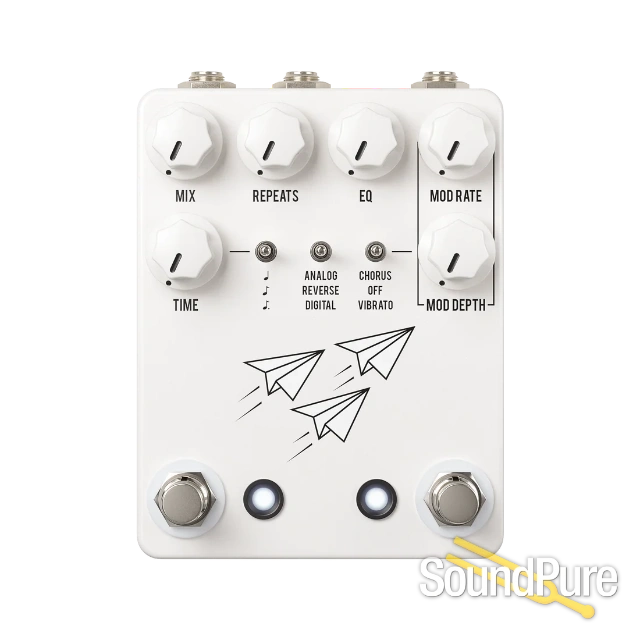
MIX - Controls the mix of delay with your dry signal. All the way left is fully dry, all the way right is fully wet. Noon is a 50/50 blend.
REPEATS - Controls the amount of feedback or repeats in the delay signal. Left is less, right is more. Fully right will give infinite repeats. Be careful! This feature can quite literally spiral out of control.
EQ - Adjusts the tone or color of the repeats. Left is a darker, warmer delay tone. Right is brighter and crisper.
TIME - Controls the length of the delay from 50ms to 1 second. Left is shorter, right is longer.
MODES
ANALOG - A filtered analog-style BBD delay that harkens back to classic echo pedals like the
EHX Memory Man and BOSS DM-2.
REVERSE - Plays the delay signal backwards, inspired by effects like the Danelectro Back Talk and Line 6 DL4 Reverse mode.
DIGITAL - Crisp, digital-style delay that pays tribute to early DSP delays like the BOSS DD-5 and the Ibanez DE7.
**Note: when switching between modes, the delay time will default to the Time control setting.
SUBDIVISION TOGGLE
Sets the interval of delay repeats - quarter note, eighth note, or dotted eighth note in relation to your tapped tempo.
TRAILS BYPASS MODE
Allows the repeats to trail when the pedal is bypassed. To activate or deactivate, hold both footswitches for two seconds while the pedal is on. The left bypass LED will blink, and the setting will be retained.
MODULATION
The flight delay features a meticulously designed modulation path that affects the delayed signal. This can be used to perfectly emulate the modulation textures of a *Memory Man’s vibrato’d repeats or a vintage tape delay’s lo-fi warble warble and everything in between.
MODULATION TOGGLE - Sets delay modulation style to chorus, vibrato, or off.
MOD DEPTH - Controls the depth or level of the modulation effect. Left is less, right is more.
MOD RATE - Controls the rate of the modulation. Left is slower, right is faster.
TAP/EXPRESSION CONTROL FOR DELAY TIME
TAP - For external tap control, plug a mono TS cable into the TAP/EXP jack and connect to a switch or clocking device.
EXPRESSION - For control of the delay time with an expression pedal, plug a stereo TRS cable into the TAP/EXP jack and connect to an expression pedal with the polarity set to “Tip”. Heel down produces the fastest delay time, and toe down produces the slowest delay time.
LEFT FOOTSWITCH - Bypass switch, which turns the effect on and off.
RIGHT FOOTSWITCH - Tap tempo switch. Tap in your tempo with two or more presses to lock in your delay time. (This will reset to the Time control setting when changing modes.)
I/O & POWER
MONO INPUT - 1/4” jack on the top right side of the pedal.
MONO OUTPUT - 1/4” jack on the top left side of the pedal.
TAP/EXP JACK - 1/4” jack on the top between the input and DC jack.
POWER - Requires 9VDC negative center power and consumes 85mA. Do not use more than 9VDC, or you will void your warranty.
THE JHS PEDALS FLIGHT DELAY IS IN NO WAY AFFILIATED WITH OR ENDORSED BY IBANEZ, BOSS, DANELECTRO, ELECTRO-HARMONIX OR LINE 6.
- Product Name
- JHS Pedals Flight Delay
- Effect Type
- Delay
- Design Goal
- Simple, essential delay pedal (no menu diving)
- Delay Modes
- Analog (filtered analog-style BBD)
Reverse
Digital
Mode Inspirations
- Analog
- EHX Memory Man, Boss DM-2
- Reverse
- Danelectro Back Talk, Line 6 DL4 Reverse Mode
- Digital
- Boss DD-5, Ibanez DE7
- Delay Time Range
- 50 ms – 1 second
Controls
- Mix
- Dry to fully wet (50/50 at noon)
- Repeats
- Feedback amount (infinite repeats fully clockwise)
- EQ
- Tone of repeats (dark/warm to bright/crisp)
- Time
- Delay length (50 ms to 1 second)
- Subdivision Toggle
- Quarter Note
Eighth Note
Dotted Eighth Note
(Relative to tapped tempo)
- Bypass Mode
- Trails Bypass Mode
Activated/Deactivated by holding both footswitches for 2 seconds
Setting is retained after power off
- Modulation
- Modulation affects delayed signal only
Emulates Memory Man-style vibrato and vintage tape delay warble
Modulation Controls
- Modulation Toggle
- Chorus / Vibrato / Off
- Mod Depth
- Modulation depth
- Mod Rate
- Modulation speed
- Tap / Expression Control (Delay Time)
- External Tap Tempo via mono TS cable
Expression Pedal Control via stereo TRS cable (Tip polarity)
- Heel down
- fastest delay
- Toe down
- slowest delay
Footswitches
- Left Footswitch
- Bypass (on/off)
- Right Footswitch
- Tap Tempo
I/O
- Mono Input
- 1/4"
- Mono Output
- 1/4"
- Tap/Expression Jack
- 1/4"
- Power Requirements
- 9V DC Negative Center
- Current Draw
- 85 mA
Do not exceed 9V DC
- Disclaimer
- Not affiliated with or endorsed by Ibanez, Boss, Danelectro, Electro-Harmonix, or Line 6
Free 3-Year Warranty
In addition to the standard included manufacturer warranty, virtually all new products carry our exclusive, industry-leading, absolutely free Sound Pure 3-Year Warranty, which includes parts and labor. It's our way of adding real value to the personal touch our small, dedicated team brings to every purchase.
Coverage exclusions live in Terms & Conditions, Section 27. Read the warranty →

Sound Pure Studios · Durham, NC
Come hear it in our control rooms.
Sound Pure is a working studio in Durham, NC — a 1,000 sq ft live room and two pro control rooms. Book a session to audition gear in a world-class acoustic space before you buy.