Free guitar clinic: Alex Skolnick of Testament, live at Sound Pure on Sun, Oct 18 at 5:00 PM. Reserve a seat

Sound Pure's Take

Condition: Used, Good

Guitar has some dings on the horn as well as on the headstock, pictures of these blemishes are in the gallery.

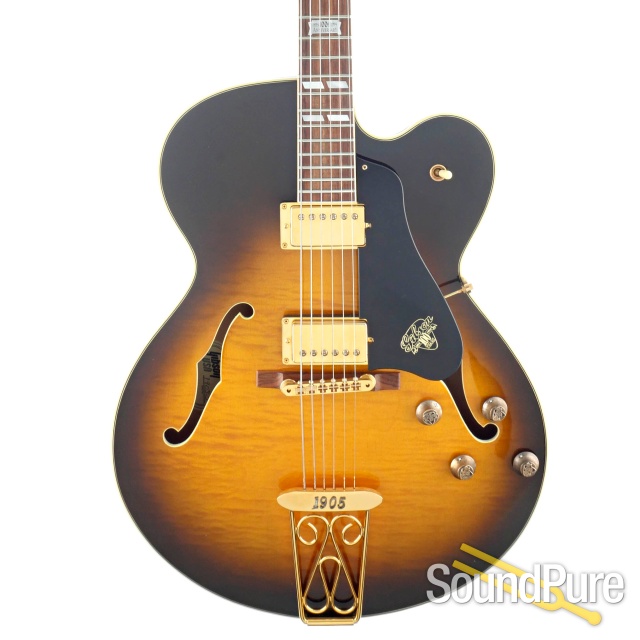
We always enjoy playing Gibson's solid wood archtops, and this L-4 CES is a fantastic blend of acoustic and elctric sounds with excellent playability that is specifically here for our left handed customers. The short scale and 1 11/16" nut width really help with feel for those who don't like "fighting" their guitars everyday and this L-4 really lets the music flow without the instrument getting in the way. Tonally you'll notice a warmth in the midrange that is a throwback to archtop guitars' acoustic beginnings but also an overall clarity that will highlight and reward your clean playing. If you're a lefty stuck somewhere between flattops and archtops or looking for a warmer sound than your maple jazz boxes please consider this Gibson L-4 CES while it is available!

From Gibson Guitars

The Gibson L-4 archtop became jazz’s greatest rhythm instrument in the hands of six-string innovators like the virtuoso Eddie Lang in the 1920s and assured the company’s dominance of the guitar market even before the outbreak of World War I. But the L-4’s story - how it evolved from an acoustic guitar to the dynamic L-4 CES Mahogany Archtop of today - is perhaps the best illustration of Gibson’s historic dedication to endlessly refining and improving instruments that are already world class.
The L-4 was developed as a louder, bolder update of Gibson’s popular L-1 and L-3 designs, advertised as a “grand concert size” model with 20 frets, one more than its predecessors. The L-4’s top changed radically in 1935 when, under the direction of the company’s famed designer Lloyd Loar, the round sound hole was replaced by a pair of f-holes to enhance tone and projection. During the ‘40s, many elements were added including crown pegheads and parallelogram inlays on its fingerboard, but the biggest innovation in the guitar’s design came in 1949 with electrification.
To meet the demands of the dawn of popular music’s electric age, Gibson first created the laminated top ES-175 in 1948 based on the construction of the acoustic carved top L-4. But players still wanted a genuine electric full-bodied L-4 with a carved top. The first wave of these guitars were built in small batches throughout the 1950s, but were perfected late in the decade. Along the way the guitar’s body traded its rounded edges for a single cutaway horn to allow easier access to the high notes – a sign of the L-4’s evolution from rhythm to lead-and-rhythm instrument. Finally, in 1958, the design reached a pinnacle with a run of 20 guitars bearing the Gibson L-4 CES name. Some had Charlie Christian pickups, others Alnicos, and a few sported humbuckers. Over time the humbuckers proved the most versatile and practical, and thus today’s graceful mahogany L-4 CES model reached maturity.
Year
2002
Serial Number
23152002
Top Wood
Solid Carved Spruce
Back Wood
Solid Carved Mahogany
Neck Wood
Mahogany
Fretboard Wood
Ebony
Fretboard Inlay
Pearl Split Parallelogram
Fretboard Binding
Single-Ply White
Neck Shape
ES Rounded
Scale Length
24 3/4"
Nut Width
1 11/16"
Hardware
Gold
Pickups
'57 Classic Humbuckers
Controls
Volume, Volume, Tone, Tone, 3 way
Tailpiece
L4
Bridge
ABR 1
Tuners
Tulip

Hardshell Case

Warranty

This item is sold without the Sound Pure 3-year warranty (used / B-stock / dealer-exempt). Coverage terms for items in this category live in Terms & Conditions, Section 27.

Returns

Try Before You Buy: take it home, commit only when it's right. Program details →

Sound Pure Studios Control Room A — Durham, NC

Sound Pure Studios · Durham, NC

Come hear it in our control rooms.

Sound Pure is a working studio in Durham, NC — a 1,000 sq ft live room and two pro control rooms. Book a session to audition gear in a world-class acoustic space before you buy.