
Sound Pure's Take
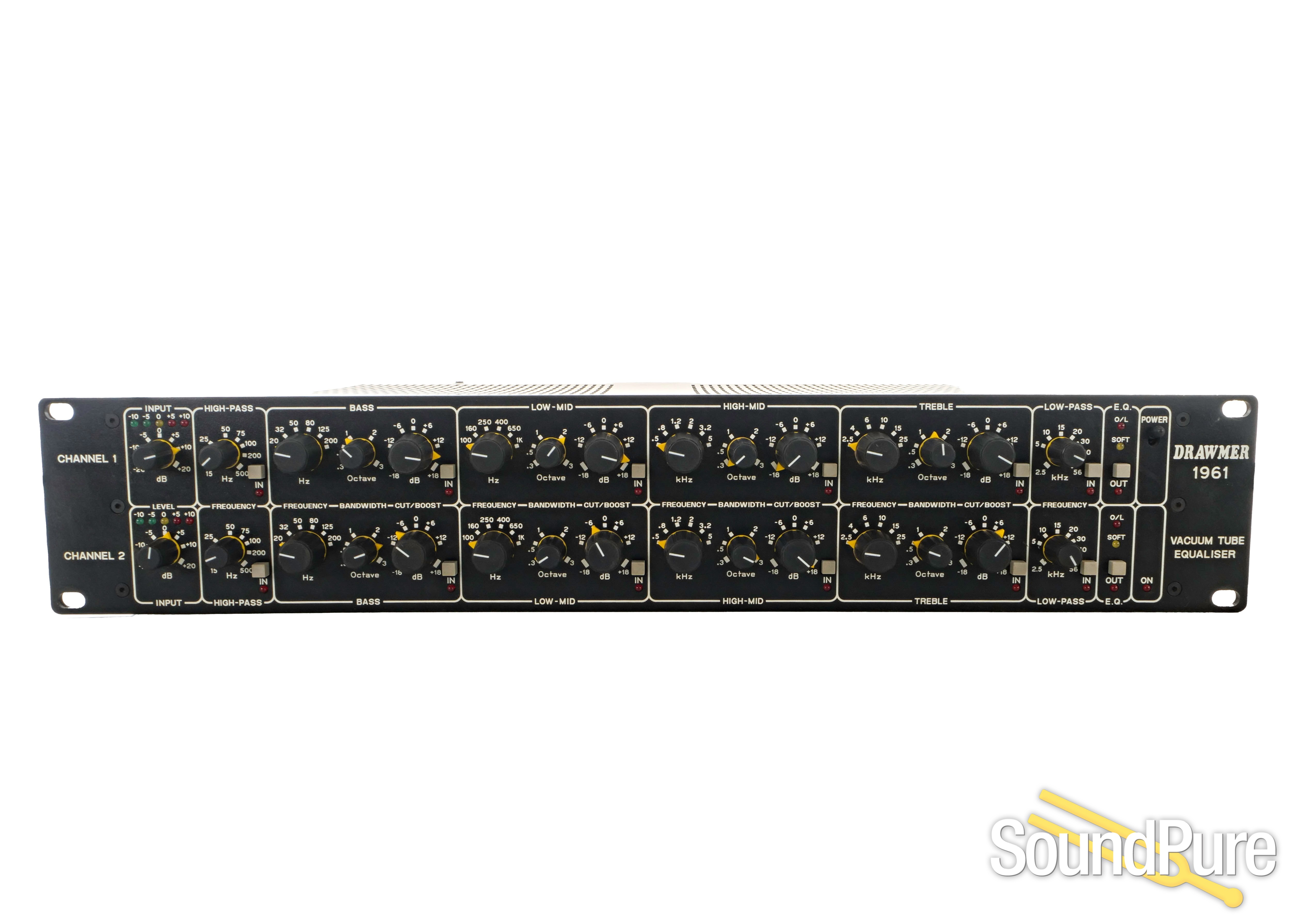
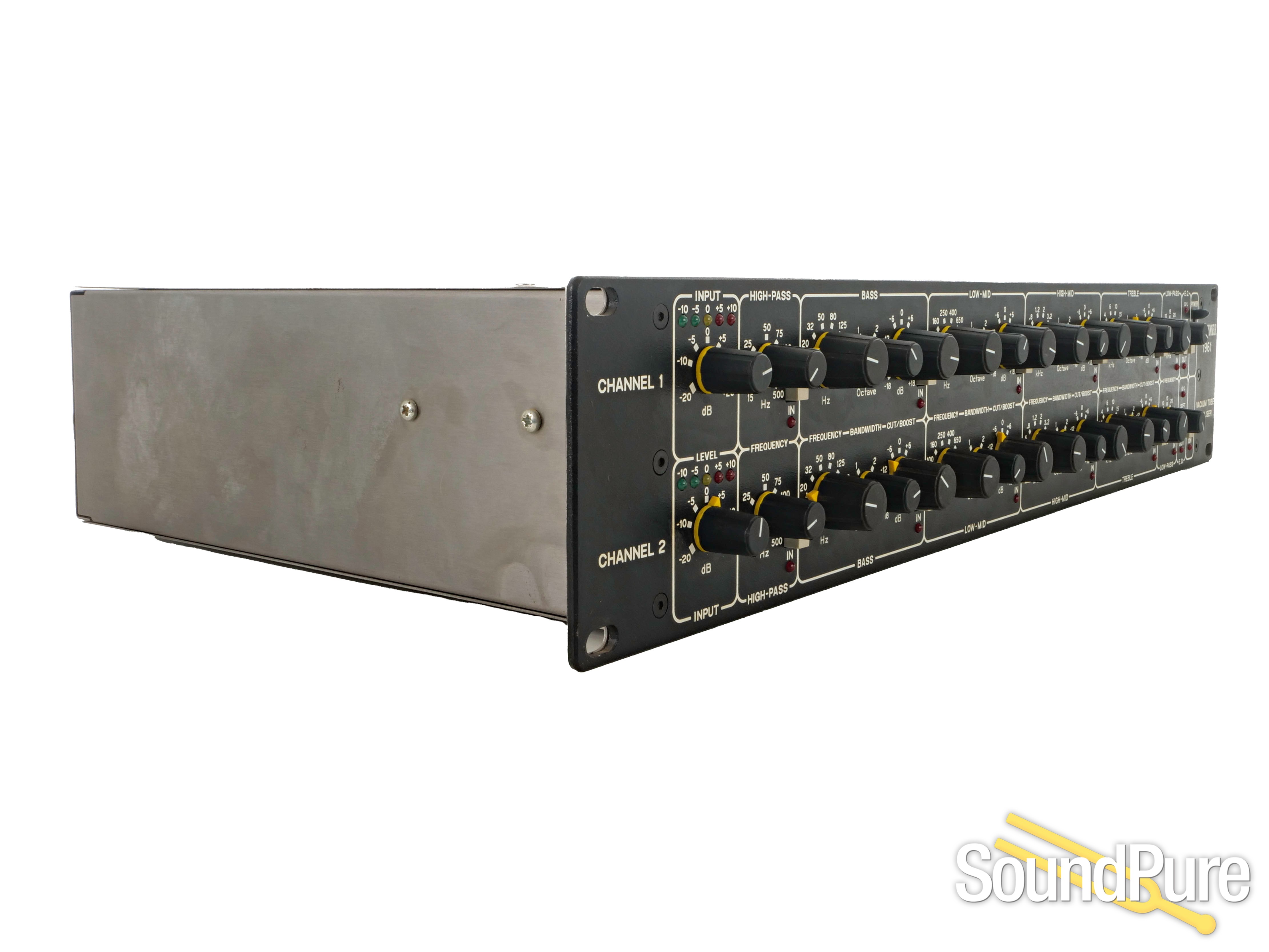
The Drawmer 1961 is one of those EQs that doesn’t just shape tone—it enhances it in a way that feels immediately musical.
At its core, it’s a tube EQ with a gentle, mastering-friendly approach. The curves are broad and forgiving, making it easy to make meaningful changes without ever sounding harsh or overdone. Whether you’re adding air to the top end, tightening up the low end, or subtly reshaping the midrange, the 1961 has a way of making those moves feel natural and cohesive.
What really stands out is the depth it brings. There’s a sense of openness and dimension that comes from the tube circuitry—highs feel smooth and extended, lows feel round and controlled, and the overall image gains a bit more space and polish.
It’s especially strong on mix bus and mastering applications, but it’s just as useful on individual sources when you want broad, musical tone shaping rather than surgical correction.
For engineers looking for an EQ that prioritizes feel and musicality over precision tweaks, the Drawmer 1961 delivers a classic, polished sound that’s easy to trust.
From Drawmer
It has long been recognized that vacuum tubes impart a unique ‘warmth’ and ‘musicality’ to an audio signal, but many of the ‘classic’ tube equalizers fall short of the technical performance demanded in today’s digital recording age. Designed to complement the widely acclaimed Drawmer 1960 Mic Pre-Amp Vacuum Tube Compressor, the 1961 Vacuum Tube Equalizer combines low noise circuitry with no fewer than twelve active tube stages to provide two channels of exceptional equalization possessing unique ‘personality’. Rather than employ a continuously variable resistor as a means of frequency control, the 1961 utilizes the same rotary ‘step’ switching system used in vintage designs . This enables the component values for each frequency band to be optimized for uncompromising performance across the entire audio spectrum and also makes setting up more accurate, particularly when treating stereo signals.
The design of the 1961 allows the user to control the amount of ‘warmth’ by deciding how hard to drive the tubes giving a sound as ‘clean’ as the best discrete solid state designs or as ‘hot’ as the ‘hottest’ classic tube designs. The 1961 and 1960 Can be ‘interlinked’ to provide, in effect, a two channel vacuum tube mixing console, – the perfect mastering or post audio ‘sweetening’ tool.
Features:
- Input level : A variable input level of -20dB to +20dB ensures compatibility with a wide range of input source material and enables the user to optimize signal level and drive the tubes ‘soft’ or ‘hot’ as required. LED bargraph displays give a clear indication of the input signal level.
- High Pass Filter : A variable 12dB/Octave roll-off filter adjustable from – 15Hz to 500Hz section enables the user to remove unwanted low frequencies and sub-sonic noise.
- Equalization : Each channel of the 1961 has four main equalizer sections with six carefully chosen overlapping frequencies and a separate tube stage for increased harmonic clarity. Each section also includes variable band width from 0.3 Octave to 3 Octaves and +18dB of Cut and Boost. BASS frequencies (Hz) 20, 32, 50, 80, 125, 200. LO-MID frequencies (Hz) 100,180, 250, 400, 650,1K. HI-MID frequencies (kHz) 0.5, 0.8,1.2, 2.0, 3.2, 5.0. TREBLE frequencies (kHz) 2.5, 4, 6,10,15, 25.
- Low Pass Filter : A variable 12dB/Octave roll-off filter adjustable from 2.5kHz to 56kHz enables the user to remove high frequency interference or to band limit excessively high levels of high frequencies.
- Output Stage : Two additional tube stages in the output section of each channel allow the user to achieve ‘soft clipping’ by adjusting the input level control whilst visually monitoring the effect upon the ‘Soft’ and ‘O/L’ (Overload) LED’s.
- Bypass : In addition to a master bypass switch for each channel each of the parametric and shelving filters has its own separate bypass switch. This not only makes the 1961 very straight forward to set up, by allowing instant A-B comparison ,but also enables the tube output stages to be used to add tube coloration without EQ simply by leaving each channel switched to ‘In’ and each individual EQ sections switched to ‘Out’ The master bypass switch for channel bypasses all the filter sections as well as the output stage vacuum tube circuitry.
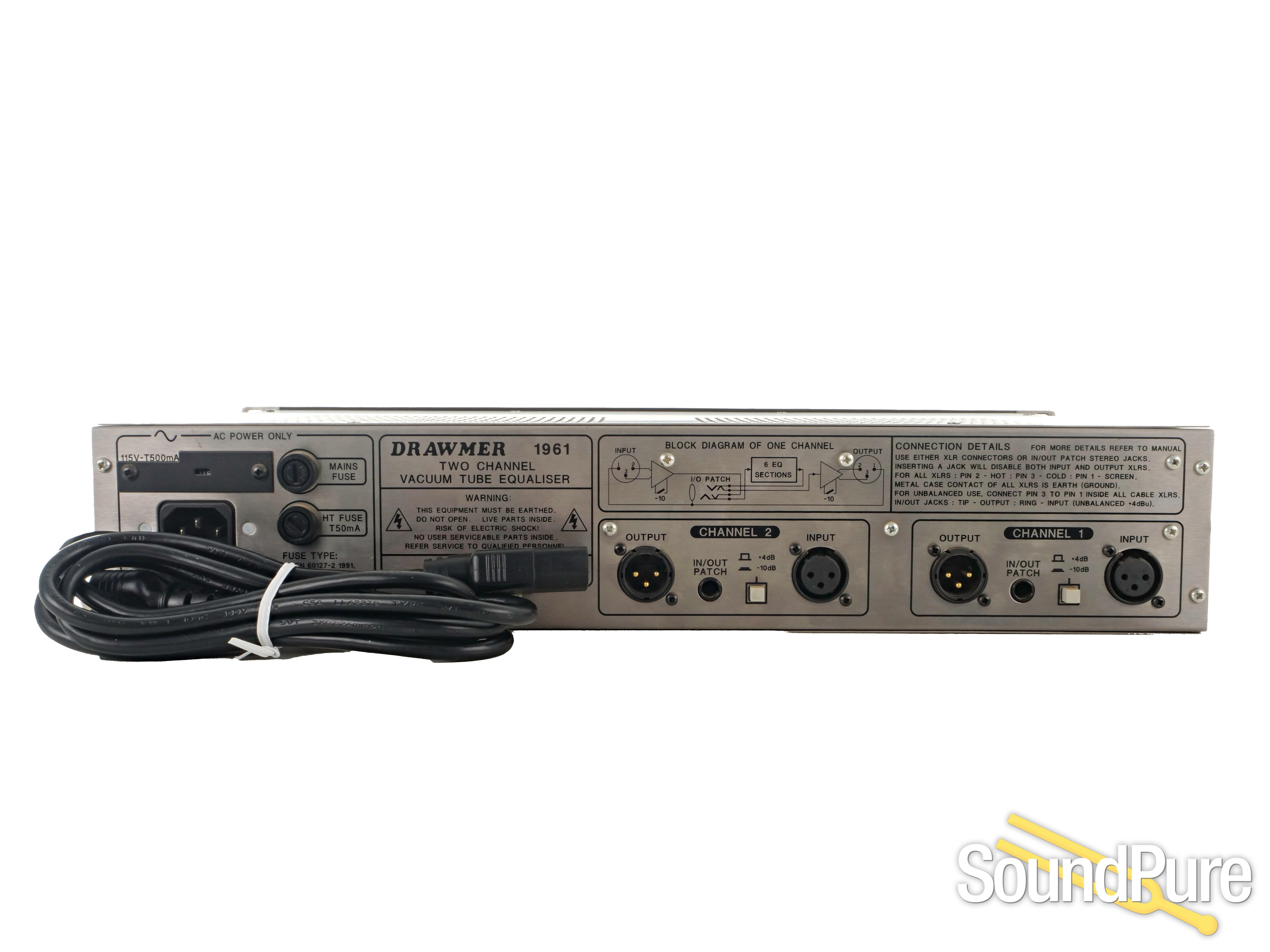
- Operating Level : Levels of -10dBu and +4dBu are selectable using a rear panel switch.
- Insert Connections : Insert point 1/4″ jack connectors on the rear panel enable direct connection to the Side chain or Insert points of the Drawmer 1960 Mic Pre-Amp/ Vacuum Tube Compressor. The 1961 and 1960,when’interlinked’, produce a powerful package for recording signals direct to tape; gain control, EQ and compression can be applied to both mic and line level signals without having to go via a mixing console.
- Inputs and outputs : The 1961 is provided with balanced inputs and outputs on XLR connections.
General
| Frequency Response | <22 Hz to 42 kHz (-1 dB) |
|---|---|
| Input Impedances | XLR: 20 Kilohms Insert: 47 Kilohms |
| Output Impedances | XLR: 50 Ohms Insert: 200 Ohms |
| Maximum Input Level | +17 dB / +21 dBu |
| Crosstalk | <-80 dB (at 10 kHz) <-75 dB (at 20 kHz) |
| Input CMRR | >40 dB (20 Hz to 20 kHz) |
| Noise | -97 dB (A-Weighted) |
| THD + N | Bypass: <0.1 % (at 1 kHz) Normal: <0.3 % (at 1 kHz) |
Inputs / Outputs
| Audio I/O | 2x XLR 3-Pin Line Input (1 Stereo Pair) 2x XLR 3-Pin Line Output (1 Stereo Pair) 2x 1/4" TRS Input/Output (Link I/O) |
|---|
Power
| Power Source | AC Input (Built-In) |
|---|---|
| Power Consumption | 28 W |
| AC Input | 115 / 230 VAC at 50/60 Hz |
Environmental
| Certifications | CE |
|---|
Physical
| Mounting | Front: 4x Standard Rackmount Hole |
|---|---|
| Color | Black |
| Material of Construction | Metal |
| Dimensions | 19 x 9.8 x 3.5" / 48.2 x 25 x 8.8 cm |
| Weight | 13.4 lb / 6.1 kg |
Warranty
This item is sold without the Sound Pure 3-year warranty (used / B-stock / dealer-exempt). Coverage terms for items in this category live in Terms & Conditions, Section 27.
Returns
Try Before You Buy: take it home, commit only when it's right. Program details →

Recommended accessories

Sound Pure Studios · Durham, NC
Come hear it in our control rooms.
Sound Pure is a working studio in Durham, NC — a 1,000 sq ft live room and two pro control rooms. Book a session to audition gear in a world-class acoustic space before you buy.