
-
Call Us Toll Free888-528-9703
-
Local/International (+1)919-682-5552





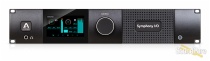
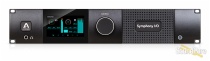
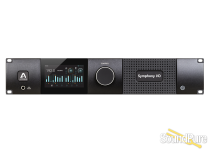
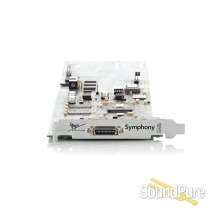
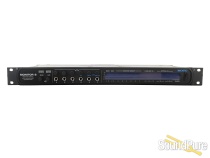
World class studio audio interface, Special Edition, with 8x8MP Connect card, 16x16SE card, 8x8 AES, Optical SPDIF/SMUX/ADAT, Coax SPDIF, Word Clock In/Out, Thunderbolt 2, and a remote. In Used, Excellent condition

This one is sold. Don't miss the next one. Some things never even make it to the site so stay up to date on our used collection.
We get in many oddities, rare and vintage products, most of which go fast. If you're on the hunt for something specific, something unique, or something priced right, let us notify you on our used collection before the items even hit the site.
Want to know if one lands?
Notify MeWant to discuss what's coming?
How do you improve upon one of the best sounding multi-channel converters on the market? That was the goal for Apogee’s exciting new Symphony I/O MKII, which features a sleek new touch screen display, a standard Thunderbolt connection option, and further improved converter technology. Additionally, Apogee plans to add connectivity options through HD and SoundGrid expansion cards later this year, giving the Symphony system even more compatibility with a huge amount of existing systems. One of our absolute favorite improvements to the Symphony design is a quieter cooling fan. The fan on the previous model was known to have occasional noise issues when recording quieter, more intimate sources in the same room as the Symphony system, so this improvement is sure to make the lives of home-studio engineers after pro-level converter technology much easier!
The best sounding Apogee converters and mic preamps ever
Symphony I/O builds upon the award-winning design approaches of Apogee’s X-Series* and Rosetta Series converters*, the Big Ben master clock and the Trak2 mic preamps. It also refines and updates these proven designs with fewer but more advanced components while optimizing their performance with efficient power distribution. These enhancements allow audio to travel through less circuitry, offering lower converter latency, more accurate clocking and even more transparency and clarity in your recordings.
Apogee's engineers do not merely rely on specs and data sheets when selecting converter components, they listen. Each component is auditioned and carefully selected to best reflect the characteristics of the Apogee sound. Symphony I/O’s audio path design is elegant and efficient, incorporating the most advanced opamps that offer better performance than multiple parts used in previous designs.
This design improvement minimizes the audio path circuitry and maximizes sound quality. And in the tradition of the X-Series and Rosetta series, the entire audio path is DC coupled, resulting in ultra flat frequency response and extremely low phase error.

Apogee was founded in 1985 and initially made its name designing filters. Later, Apogee's complete conversion systems pushed the envelope of digital audio quality and solved many of the early problems with digital audio technology. Apogee converters have become regarded as the reference standard for digital audio conversion. Products such as the award-winning Rosetta 800, AD16x and DA16x have become the modern benchmark by which digital audio conversion is judged. A new generation of Apogee products including the revolutionary Symphony I/O, with its modular design and flexible connectivity, promise to extend the Apogee legacy and further advance the art of digital audio.
Analog to Digital
Digital to Analog:
Headphone Output:
Power
Connect 8x8MP Expansion Module
Analog and Digital INPUTS:
Analog and Digital OUTPUTS:
*Dig I/O hardware switch selects AES or Optical digital I/O format
16x16SE Analogue Module
INPUTS
OUTPUTS

© Sound Pure LLC 2026. All Rights Reserved.











 919-682-5552